
Hello, everyone. This is Shima from Oubaitori.com.
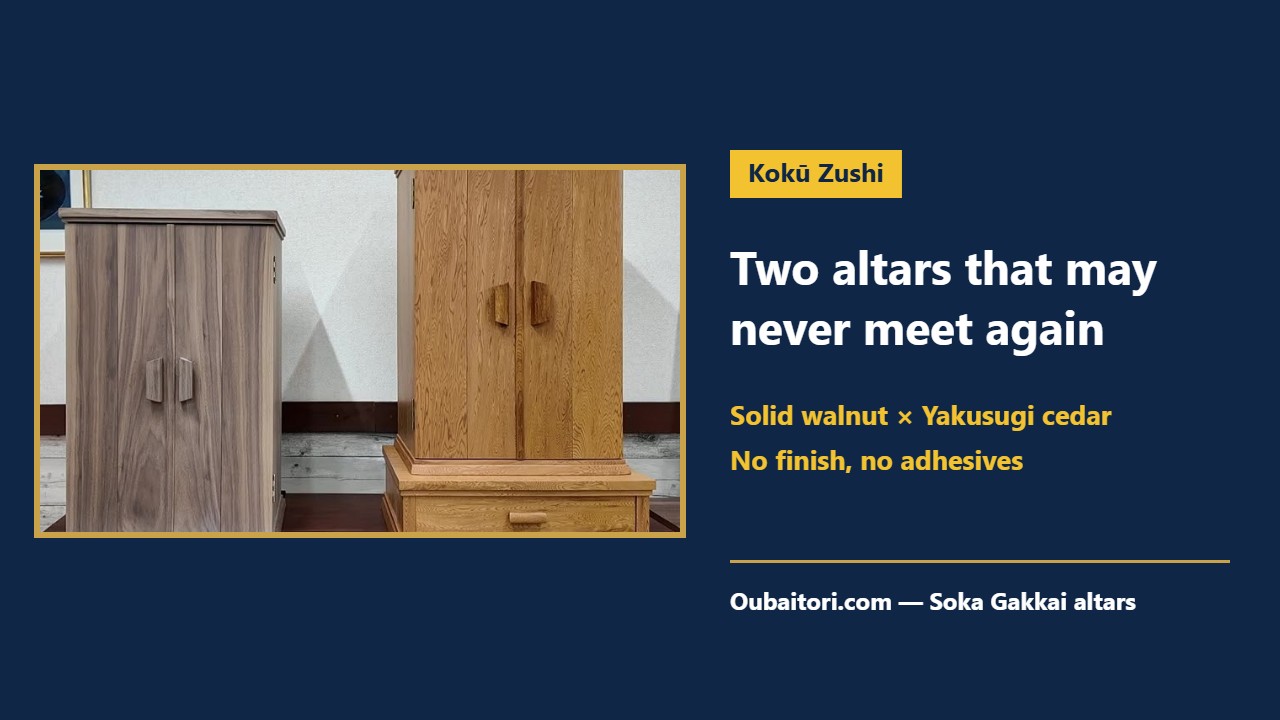
Today I filmed something I simply had to record. On the left is a Kokū Zushi made of solid walnut. On the right is a Kokū Zushi made with Yakusugi cedar veneer. The chance of these two standing side by side ever again is close to zero.
A butsudan made by a man who once struggled to chant daimoku — made so that you will want to chant. In November 2026, these two stood together.
Why the walnut has no shine at all
Unlike the one on the right, the walnut altar has no gloss whatsoever. That is because it has no finish. It is a special order, built board by board from solid wood.
The customer has multiple chemical sensitivity, so the altar could not be made with petroleum-based finishes or adhesives. These are things so common today that nobody even notices them, and normally no butsudan can be made without them. This one uses none at all.
The customer asked us, “Can you make one without any of them?” Together with the workshop, we worked through trial and error. In the end, the craftsmen said they had never gone this far before. Tomorrow it will be delivered to its home in the Chubu region of Japan.
And on the other side: Yakusugi cedar
Yakusugi cedar is no longer available on the market. This altar was built from Yakusugi veneer that the workshop had kept in its own storehouse.
The craftsmen held to their standards to the very end. At first they made the handles from veneer. Then they asked themselves, “Is this really my best?” In the end, they remade the handles in solid wood.
Because the Yakusugi altar uses veneer, the base is MDF, and it has a finish. That is why its color looks the way it does.
Caring for solid wood
The solid walnut has no finish. If a steam humidifier is used nearby, the wood absorbs all of that moisture, and this can cause it to warp. Please do not use one near the altar.
For cleaning, please do not use an ordinary towel. Wipe gently with a dry Japanese tenugui cloth.
With everyday use, the natural resin and oils of the walnut come up from inside the wood, and its color changes over time.
Yakusugi turns amber with time
The Yakusugi altar is made by applying veneer less than a millimeter thick to MDF. The handles and the vertical frame lines, called the “ogami,” are solid wood.
Even though the veneer is that thin, Yakusugi’s natural sap is very strong, so over time it turns a deep amber color. It is a butsudan whose character you can enjoy as it changes.
That is the introduction for today. Next, I will show you the solid walnut altar in detail, and on another day I will film the Yakusugi altar. This is truly rare footage. Please look forward to it.
Yukihiro Shima, Oubaitori.com
Let’s Daimoku!
Bloom your own way, at your very best.
Oubaitori.com — Japan’s specialist in Soka Gakkai Buddhist altars
📱 Talk directly with us (LINE)




Comments