
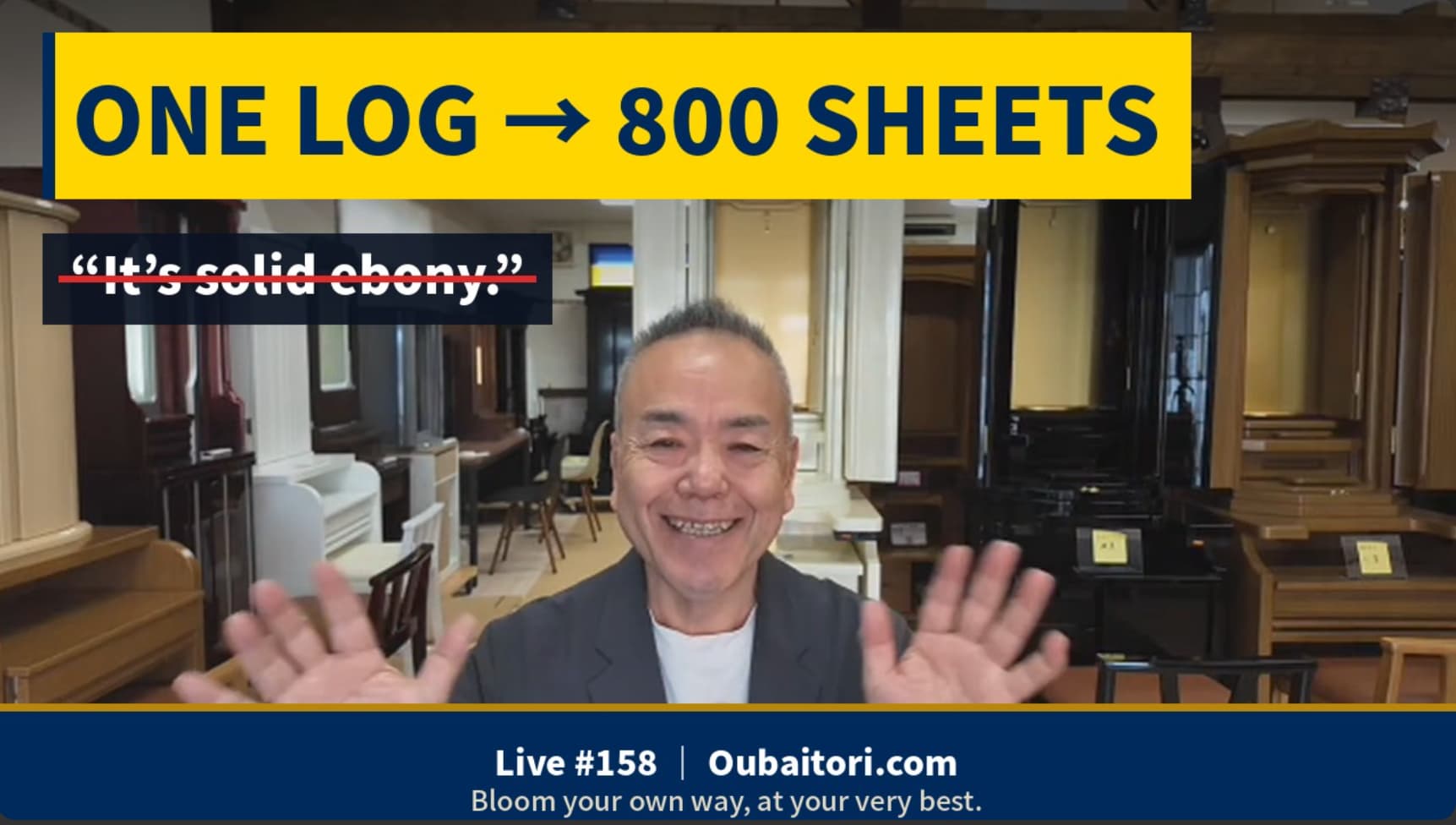
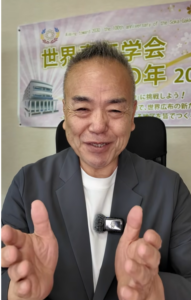
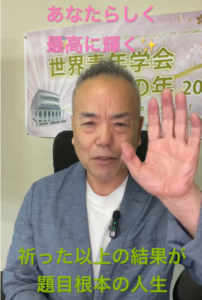
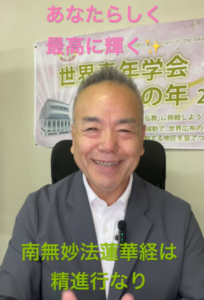
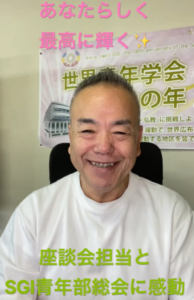
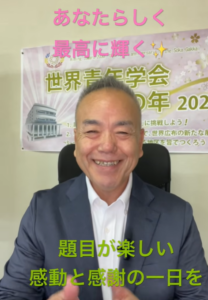
Good morning. Saturday, September 19th. This is Shima, from Oubaitori.com. The YouTube live is beginning. Have you been well this week? Today is number 158.
A man who never finished anything, and here he still is
The numbers stacking up like this — it is a good feeling. I was a man who gave up on everything after three days. Only in the moment, no staying power. That was my character. And here I still am.
It is all thanks to daimoku.
But it is not about piling up years. A year is time. And that time is either full and worth something, or it is the kind you look back on and think, what was I doing. The same time. The same person, the same hours — if you are healthy and alive like this, it is the same.
I do not want to become an “if only” old man
“If only I had.” “If it had been.” That is the old man you become. I do not want to become that old man.
As long as I tell my grandchildren “I am going to be a Super Grandpa,” then whenever they come — and with video calls now, you never know when — the thought should land: he really is a Super Grandpa, every time I see him. Not by trying hard. Not by stretching. Not by putting on a show. Just as I am. I want to live so that “our grandpa is a Super Grandpa” lands in their life on its own.
How about you?
Not telling. Showing.
A message came in just before this, from a customer on YouTube or LINE. Her husband used to be active. Now he is not. As his wife, she wants to say: why don’t you chant. Or perhaps she has already said it.
It is the same as before. You think you should just say it. But if it were said to you, how would that feel? So, if anything — you show it.
The morning of our family gathering, and a question from a grandchild
Yesterday, at a delivery, a customer asked me what my family is like. I told them: spring, summer and winter, the grandchildren come and we have a gathering at our house.
The morning daimoku, ten thousand a day, is in its fourth year now. A little over three years ago I was a man who could not chant much at all. Then it began to come.
When the gathering starts, the children wake up and Grandpa is already in front of the altar, chanting. One of them came down the stairs and asked, “How much do you do?” Ten thousand, I said. “Ten thousand? How much is that?” And then: “Grandpa, what do you get out of chanting ten thousand times? What is it for?” Eyes shining. Why does he sit here, facing the altar, and chant. That is what interested them.
The interest lasts only that moment. With a child, everything depends on whether you can answer right then.
I answered straight away. “So I can be a Super Grandpa!” And then: “If I chant too, will I be a Super Me?” Of course you will. If you want to be a Super You, you had better chant.
And then they chant along with me. And they are delighted. Of course it does not last long. You must not try to make it last. You must not tie them to it.
The moment they take an interest, you answer. And you let them see you doing it. Every morning of the gathering. Who gets up first — we do that too. And whichever grandchild comes down first, Grandpa is already chanting. That is what they see.
“Do you always do this?” Always. Not just during the gathering. All the time. And so I can say: today is number 1,167.
“Grandpa, it sounds like something else”
It is funny. My grandchild in the second grade slipped away from beside me, sat down on the sofa, and announced: “Grandpa, it sounds like nande yanen to me!” — a joke phrase from the comedians on television.
I am saying Nam-myoho-renge-kyo, and that is what he hears. Straight down the middle, no holding back. So I said, plainly: “I see. What I am chanting is Nam-myoho-renge-kyo.” Not angry. Keeping that line of communication open is what matters.
This week: the monthly books, and a visit to the workshop
Monday, the accountants came for the monthly closing. Every month, we close the books. It is demanding.
Tuesday I went to Tokyo, to the workshop, to see how the custom altar ordered from Hong Kong is coming along. The parts have been finished and painted. From here they assemble it.
One log becomes eight hundred sheets
In the afternoon I went to Shinkiba, to see how veneer is made. You have heard of a log being sawn into boards. The thickness here is different. Not one or two centimeters. 0.02 millimeters.
I was astonished. I thought it would be transparent. Not at all. It still has the feel of wood in your hand.
Their showroom — it is really a museum. We were shown through it: myself, the workshop, and Kimura. The three of us.
There are so many kinds of work in this world. Whole fields I know nothing about. And yet somewhere in the world, what they make is being used. That is what I learned.
One log, cut lengthwise into about 800 sheets. Like cloth let down into a river to be dyed. Stacked back together, it becomes a single tree again.
And then — do you know katsuramuki? Peeling a daikon radish with a knife, one continuous sheet coming off the outside as you turn it, the way you prepare the garnish for sashimi. They peel a log like that, roll it back, cut it again, and design the grain. At that point I could no longer picture it.
Thinking that far ahead, building all of that — and the company is in its 104th year. I was amazed.
One tree, opened out eight hundred times over
What impressed me more: a tree of about three meters, cut into 800 sheets. One log would otherwise make one log’s worth of anything. By applying those 800 sheets, the true grain of the natural wood can be laid down 800 times over. This connects to sustainability, I thought.
As amateurs we think: you need a board two or three centimeters thick, and then the edges become waste. From here, it is sliced into 800 and opens out 800-fold.
And there is this. In South America there are walnut trees. They grow old, and stop bearing. Once a tree bears nothing, it simply stands there. Turn it into a log, and it has a beautiful grain.
So this company plants, grows the trees, makes it work for that country, and when a tree is old, it is cut and exported — contributing to that country’s economy, using one tree fully, and sending it out to the whole world. It is on a grand scale. That is the thinking a company is being run on.
I went nervous about whether a small operation like ours could even open an account with them. “That is fine,” they said. The workshop is the maker, so through the workshop we can trade.
And when I asked whether I could write about how moved I was, on the blog: “Of course.” May I use material from your website? “Of course. Link to us, if you like.”
That is a large vessel. Making their own unshakable position more unshakable still, and opening a hand to someone new who hopes for something. I was grateful. The top of their field. Not only first in Japan — first in the world, I would think.
An altar with no paint and no glue
Why did I go there? Because of the Kokū Zushi I have designed. The simple standard model, the first one I developed, has steadily found its people.
And this time, an inquiry came from someone with chemical sensitivity. We spoke on the phone several times. Paint thinner, adhesives — anything volatile — and their body reacts. “If it is your shop, could you build a Kokū Zushi without those?” That is how it began.
I always begin from “yes, we can.”
Which means: no paint. And no MDF — the fiberboard that is the core material of altars today, the basic parts that become an altar when assembled. That is powder bound with adhesive and pressed into board, so it cannot be used.
Which leaves solid wood. The wood itself.
What this industry actually is
You may or may not know this. There is no altar made entirely of solid wood. Among the altars lined up and sold normally, there is no such thing. There are altars that use some solid wood in part.
As I said: veneer at 0.02 millimeters; thick veneer still measured in millimeters. There is no board measured in centimeters. Once it is centimeters, it is handled as solid timber.
People have said for decades, “it’s solid ebony.” Solid ebony products are genuinely rare. And lately ebony is said to be gone from the market, so only the old stock remains. There is no solid ebony altar.
There is no point insisting on this too hard, because it does not follow that solid is best. Solid board may warp. Left untreated, dry air and humidity will bend it. That possibility is real.
So what I have asked the workshop for this time is: build it from solid board. Use no adhesive. Apply no coating. Then — what means are open to us? That is what we are working out now, with the workshop, as we build it.
What you can see is not what it is
In this industry, when someone looks at what is in front of them and says “lovely wood,” it is usually a sheet. A printed sheet, beautifully applied. Adhesives are good now, the printing is superb, and it goes on cleanly, so it looks like wood. What covers it is a sheet. It is not wood. Inside is fiberboard — manufactured wood. That is ordinary. That is general.
The other thing: almost nothing is made entirely in Japan. Most is made in China or Southeast Asia, brought to Japan, and here the mechanism is fitted or the final adjustment is made.
Why? The thing to be most concerned about is this: there are no craftsmen. No wood craftsmen. No finishing craftsmen. That is where we are.
So if anyone watching this thinks, “I want to become a craftsman” — please get in touch with us.
What comes next for the Kokū Zushi
We have added a consultation page to the website. Q&A pages are common, but they are not really alive. So we put up the real questions we have taken over the phone, as they came. And we built a color simulator — the altar behind me is white now; what would it look like in pink.
On top of that, with the Kokū Zushi you can change the wood. The veneer can be changed: walnut, teak, and yakusugi. And karin. Karin too has apparently grown scarce. One is on order, and one more is due to be finished around October 23rd. After that, we will not be able to make it. The grain is not there.
So rather than chasing what is gone, there is what we do not yet know — and something that may turn out to suit an altar beautifully, which the veneer company may now be able to supply. Carrying hope forward into the future. That is how I live.
And this, I believe, is Nam-myoho-renge-kyo. Not “I worked hard,” not “I did this and that.” Staking your own life on it, changing your karma, and walking the drama of your own human revolution. Not relatively enjoyable. Absolutely enjoyable — because you yourself are moved, and full of joy.
The Netherlands, Australia, and only Africa left
Recently we were able to deliver to the Netherlands and to Australia. Small altars, but still. Next month, Okinawa. In November, the Kansai region. And in between, Hong Kong, by air.
I want to reach as many people here in Japan as I can — and the world as well. This is worldwide kosen-rufu.
Of the five inhabited continents, only Africa is left. If an order comes from Africa, then Oubaitori.com will have reached the world. That time may be close. To work with everything I have for worldwide kosen-rufu, to raise a swell of daimoku across the whole world — that is what came down to me when I reached ten million daimoku. So I want to live honestly, in that way.
Human × Daimoku × AI = LB³
The next book is decided: “Human × Daimoku × AI = LB³.” I expect it will stay that way.
When I say automation with AI, I do not mean it the ordinary way. Of what AI and I work out together, the work that is mine to do, I do. It has to be that way. What I am saying right now is not a script AI wrote for me — which is why I can speak to you like this.
And then, what I cannot do. I have no English. So the native English that Gordon translated — English that carries properly to members — was learned by the AI, and the English editions of Butsudan Revolution: Kokū Zushi and Let’s Daimoku! came into being. The same can now be done into Portuguese or Spanish, from what has been learned. That path is open too.
The website as well — I am having the AI write the code. “How about this.” “What about that.” “Then put it here, like this.” Our website keeps changing.
Keeping your word
Faith is a believing heart. And first of all — are you someone you can believe in?
You make a promise to someone. You may not think you broke it; perhaps you simply forgot what you agreed to. If you are going to promise, keep the promise. If you cannot, do not promise. If it will take time, say that it is taking time. Then the promise is not thrown away.
The worst thing in this faith is to break a promise.
The moment you break it, you have broken a promise to yourself first. And you have broken one with another person. Twice over. This is something to be careful about.
I give an experience every single day
I can share an experience every day. Every morning, on YouTube, that is what I am doing.
You speak. Staying silent is not right. You speak. I tell anyone, plainly, what chanting this daimoku has done for me. I told the accountant who came this week. “It is really something, you know.” Normally, naturally, every day. Inside the organization or outside it makes no difference. I think it is good, I feel it, and things are genuinely getting better. Why would I not say so? This is absolute happiness.
I run a business, so — isn’t the money frightening? And what of it? You stand squarely on faith, you chant, and you create value. Wishing for the happiness of others as well as your own.
Saying to the suppliers who matter to me, “shall we go and see this place together” — and making a new connection that way. That, surely, is many in body, one in mind. Everyone is all right. Not one person carrying the risk and putting up with it. Everyone getting better. That is what you and I are practicing this faith for.
Showing my grandchildren a Super Grandpa
I have seven grandchildren now. To them I show a Super Grandpa, properly. What a Super Grandpa thinks about, and how he goes about it. It is in the books as well.
If you stop and think, you may be doing nearly the same things every day, like a routine. And the edge goes out of it. The same people, the same situation, the same kind of day — if you mistake it for that, what a waste that is.
What contributes most here is chanting daimoku. Your perception changes. The usual routine is no longer the usual routine, and you see that it is not in fact the same. You come to live a day that looks the same and is not.
And then, further — “is this good enough?” “I want to improve this” — rises in you on its own. Not force from outside telling you to try harder. Power from your own inside.
I do not know how to be at a dead end. I never reach one. Instead, new ideas come, new thinking comes. Conditions that will not work out do appear, suddenly — and I chant Nam-myoho-renge-kyo, and then I move. I move. And it comes back around. “Thank you.” What was “we are in trouble here” becomes “thank you, we are fine,” and it settles.
Each of us can take joy in it: our own humanity, our own character, creating value, our own human revolution, and seeing where our life-condition actually is. That is the faith we have been given. And the altar is for chanting the daimoku that brings that revolution in life-condition about. As the beginning of that, I would be glad if you sought your altar from me. That is how I feel.
Every day: a breakdown, a repair, a broken switch, “I have no money.” Many of them. That is the reality. But this faith asks what you do with that reality. At this stage — well, let us repair it. And if repairing it turns the heart over, and they can chant with a fresh feeling, that is enough. “Fixed, good, same as yesterday” — then where is the human revolution in that?
Please register on LINE and tell me: here is how it actually is for me.
That is all for this week’s YouTube live. Thank you. The archive is there, so please watch it.
🙏 From Yukihiro Shima — Oubaitori.com
Bloom your own way, at your very best.
Oubaitori.com — Japan’s specialist in Soka Gakkai Buddhist altars
44 years, one specialty (est. 1982). 17,113 Soka Gakkai Buddhist altars delivered to date. Japan’s No.1 in restoring Soka Gakkai altars, 1,500+ restored. Registered trademark: “Butsudan Revolution — Kokū Zushi.” We ship worldwide.
📱 Talk directly with us (LINE)
Comments