
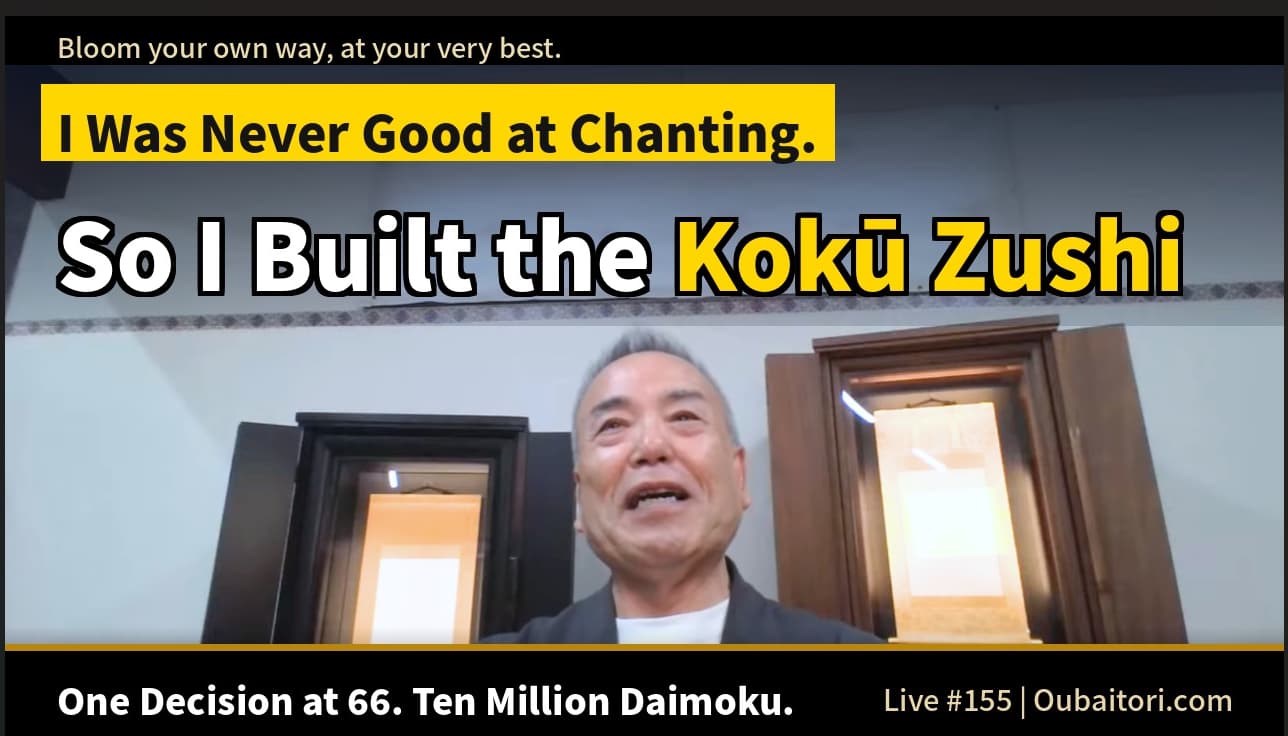
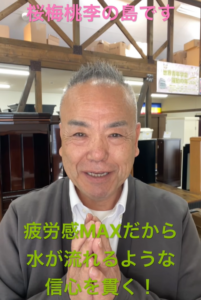
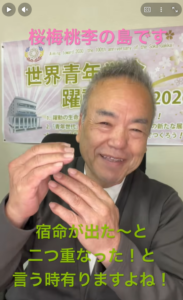
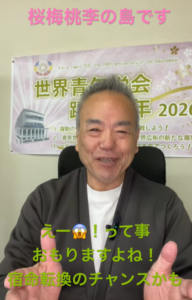
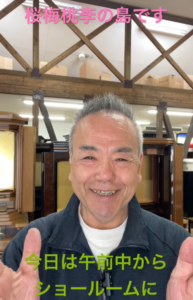
This was our live broadcast on August 29.
I sat down to talk about the Kokū Zushi behind me. Almost the whole hour turned into something else — the three years when I could not chant.
That was right, I think. The Kokū Zushi has no other origin than that.
What was blocked was not money. It was my own heart.
Three years ago I came to a dead end.
Money was hard, yes. But that was not the real problem. My own heart came to a dead end. That is the one that hurts.
Nothing had actually changed. I was living. I was working.
But I could see a little way ahead, and I did not like what I saw. Once that happens, you stop believing in your own possibility. You stop believing that the daily effort counts for anything. And then the wall you built yourself starts to press down on you.
I could not forgive myself for still crawling around in this trade. I had worked. I had studied. I had done my activities. I had done it all — and none of it had taken shape.
That is when confidence goes. And the moment confidence goes, the strength goes with it.
Almost nobody is strong all the time
Put your hand on your chest and you will know it. Some people are strong in a given moment. Nobody is strong every time. That is a picture in a storybook. I am from the generation that grew up on giant robots, so I can say it.
People are far cleverer than they think. Not clever at school — the mind itself is a remarkable thing.
That is exactly why we suffer. As long as you are alive there is something you want. Even when you cannot name it, life is quietly troubled underneath. Being troubled is simply what a human being is.
I knew the answer. I still could not do it.
We were taught the answer long ago. Face the Gohonzon. And facing it is not going through the motions of a ceremony. Facing it means chanting Nam-myoho-renge-kyo.
You chant because you decided to. Your own ears hear that Nam-myoho-renge-kyo is your own life. You look at the Gohonzon and you feel it in your body.
The heart that was going weak begins to straighten up again.
And yet. The daimoku would not come.
An hour today. Half an hour today. Tonight is fine, I will do it tonight. The mind produces reasons endlessly — it is very good at that. And nothing gets done. You just go around in circles.
I had never kept it up, and still I told myself I had already tried chanting. That is fundamental darkness.
Not being able to chant is the ordinary condition of an ordinary person. Breaking that condition is what we call changing karma.
Three thousand would not catch me up. So I chose ten thousand.
I decided at sixty-six. Four years to seventy.
Three thousand a day would not catch me up. Five thousand, seven, eight — still not enough. So: ten thousand. Even I thought it was impossible.
Even if you decide you will chant at evening gongyo, the daimoku does not come that easily. That leaves the morning. And how does a man chant ten thousand in one morning?
If I had stayed with that question I would still be asking it. You decide, and then you do it. That was all.
The decision was settled. After that, only the doing.
Thinking it through, making up your mind — those turn out to be the easy parts. Carrying it out. Putting it into practice. That is the wall.
I had to build the place I could chant in
So this is what I thought.
I have to build, with my own hands, an altar I can actually face.
That is where the Kokū Zushi behind me begins.
I went back and studied the Ceremony in the Air, and I rebuilt the zushi — the inner case that holds the Gohonzon — from the beginning.
I put it in my office at home, enshrined the Gohonzon, and chanted.
The Gohonzon is the same Gohonzon. But facing it inside a case I had made with everything I had, the daimoku came. It rose and kept rising. As if the daimoku I once chanted with President Ikeda in the Hall of the Great Vow — that force, that intensity — had returned to me.
Perhaps I talked myself into it. I do wonder.
But this part matters more. An altar does not chant for you. Without your own decision, no purchase will ever make the daimoku come.
Ten million in three years — and what came after
There were days I rested. Days I could not chant. Days I was unwell.
Even so, over three years I was able to reach the ten million I had set as my goal.
What surprised me was what came after.
One million more in the following three months. Standing on the ten million underneath it, those three months carried as much weight as the three years had. Twice the speed, three times the speed — you feel it in your life, not in your head.
Now I cannot imagine starting a day without chanting. It would be a waste.
One day out of a lifetime, perhaps. But that day returns into the whole life. None of us knows how long we have. To begin such a day without daimoku — I feel the waste of it every morning.
The ebony Kokū Zushi is the last one
Now, the altar itself.
On the right stands the ebony (kokutan) Kokū Zushi.
The workshop tells me the ebony stock is exhausted and no more can be obtained. So this is the last one. One in the world, and ready to ship as it stands.
Teak and walnut remain available. Walnut comes in several tones, and the finish changes the face of the wood again.
As posted on our site recently, 622 colours can be chosen from, and the grain can be changed as well.
For the autumn–winter model, one is being made in Yakusugi, the cedar of Yakushima in Kagoshima.
Two more were made in another scarce timber, asked for at the very end. One already has its owner, who is waiting for it to be finished.
People often ask what goes underneath. You may choose the lower cabinet yourself, or we can build it in the same timber if you would rather have it matched.
My mission: to raise a current of daimoku across the world
The part that holds the Gohonzon is the zushi. What surrounds it is the butsudan — decoration, in the end.
I have entered my forty-fifth year in this trade, and I am certain of one thing: the zushi is what matters.
I joined at six. Future Division, boys division, young men’s division — and somewhere in there I fell away for a couple of years. Because of that, I came to understand what the Gohonzon and this movement are worth.
And still it took until sixty-six for me to put daimoku at the centre. Not the surrounding cabinet: the zushi, and the Gohonzon. Three years in, now the fourth, I am learning fiercely how different that is.
So this is not about selling altars.
A Soka Gakkai altar exists so that daimoku can be chanted. I have redefined my work around that sentence.
And because we are oubaitori — cherry, plum, peach, damson, each blooming as itself — the Kokū Zushi is not necessarily the one for you.
Choose the altar you can actually chant in front of. Let that be the doorway, and walk on from there with daimoku at the centre.
One person living that way is world kosen-rufu. The more of us there are, the steadier the world becomes.
The mission I was born into this life for is to raise a current of daimoku across the whole world.
The Kokū Zushi was born along the way, while I was getting past the daimoku I had always avoided.
If you are ever in Koga, Ibaraki, come to the showroom.
Bring your own Gohonzon if you like, enshrine it, and chant. Nobody comes by, as a rule — chant as loudly as you want.
How different it feels when the zushi changes is not something I can tell you. You would have to feel it in your own life.
🙏 From Yukihiro Shima — Oubaitori.com
Bloom your own way, at your very best.
Oubaitori.com — Japan’s specialist in Soka Gakkai Buddhist altars
44 years, one specialty (est. 1982). 17,113 Soka Gakkai Buddhist altars delivered to date. Japan’s No.1 in restoring Soka Gakkai altars, 1,500+ restored. Registered trademark: “Butsudan Revolution — Kokū Zushi.” We ship worldwide.
📱 Talk directly with us (LINE)
Comments