
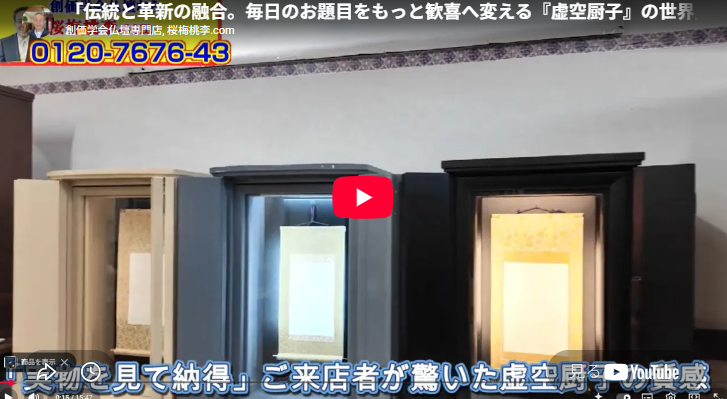
The Kokū Zushi1 is a zushi — the inner cabinet that enshrines the Gohonzon2 — designed after the Ceremony in the Air (Kokū-e)3 in the Lotus Sutra.
When a member visited our showroom in Koga, Japan, I explained it in front of the actual pieces. This is that talk, in full.
It began with one altar we rebuilt
The one on the far right is our first model. When we first built it, it was not yet a Kokū Zushi. We rebuilt it. That is where the Kokū Zushi began.
The lights come on with a remote control. You can dim them. You can brighten them. As the LED light changes, the color of the Gohonzon’s mounting changes too. The same Gohonzon — and yet this much changes.
The first generation — the Gohonzon, floating in the air
This is the first generation. I don’t keep it because it is old. I keep it exactly as it is because it was the first one we turned into a real product — the first one I was truly satisfied with.
Look closely. In front, there is a board made just for the Gohonzon. The Gohonzon is not pinned to the back wall. Step back a little and you will see it: the Gohonzon is raised.
It has to be raised into the air. Anything else would make no sense. And unless you actually raise it, it will never look that way.
In the Kamakura period, Nichiren Daishonin inscribed this single mandala, pouring his very life into the sumi ink. Its characters float. And every position on it has meaning.
The Kokū Zushi I designed asks one question: can you feel all of this more vividly? We may think things through with our heads. But in truth, we take things in with our lives. What we see — and what we can imagine — that is what matters.
From two dimensions to three — and to four
Reading The Wisdom of the Lotus Sutra4 and the Gosho, I asked myself what those floating characters express. What is written is two-dimensional. In reality, it is three-dimensional. Add time — without beginning or end; past, present and future — and it becomes four-dimensional.
Within all of that, I am living this life, now. I may lose sight of it. But my life existed in the past; it ends, and it is born again. And this moment is the “now” within all of that.
Can you feel that? By placing the Gohonzon this way, can you sense it? That is what I focused on most. That is what I thought about, in order to make something unlike any altar before it.
I want to keep chanting
I chant daimoku5 every day. Of course, it doesn’t always flow. There are days I rest.
But in the end, I keep going. I want to keep going. That is because the Gohonzon is wonderful to begin with. What the Kokū Zushi offers, I believe, is a place that connects the Gohonzon and you.
The second generation — a zushi wider than the Gohonzon
Next to it is the second generation. This is not about the outer altar. It is about how the zushi itself is made. The first generation is the width of the Gohonzon. This one goes beyond it. We designed it to look even more as if it were floating in the air.
The zushi is where the Gohonzon is enshrined; the altar around it can take any form. Because this zushi is large, you can see the Gohonzon clearly even from across the room. It isn’t about whether the altar is big or small. Because the zushi itself is solid, it works perfectly well even in a home that hosts discussion meetings.
For small spaces — and for members overseas
Some feel a small space is enough. I have heard that many members overseas do gongyo6 with their altar placed on a table. So we made a compact model too.
Light, in your own hands
The remote turns it on and off. Up for brighter, down for softer. Turn right for white light, left for warm light.
Your eyes are different in the morning and at night — and when you are tired. The same light every day, and you grow used to it. Even tired of it. Here, you adjust it to your own eyes.
By our own will, we shine light on the Gohonzon. That brings initiative — a sense that this practice is ours. Faith itself is like that. So I think an altar can carry that same initiative.
Materials, colors and shapes
Here you see an earth-tone painted finish, ebony veneer, karin veneer, and walnut. We use real wood. Colors can be custom-matched to a color sample book — even gold.
Wood veneer doesn’t suit rounded shapes. It cracks. So square shapes are veneered, and rounded shapes are painted. Two patterns. Beyond that, you simply change the design of the outer altar.
Because we build to order, the size of the doors — even the feel under your hand — can all be changed. But larger means higher cost, and the price reflects that.
A Kokū Zushi inside the altar you already have
We were also asked, “Can a Kokū Zushi go into my current altar?” It can. But the current altar has to be taken apart. If it is a gold-leaf altar, that means stripping the gold leaf — a major job.
So what I have in mind is the most compact form, with no doors at all. We have already built one for a member who wanted it to fit a very narrow space. Build close to that, and a Kokū Zushi can sit inside the altar you already have. It is less about spatial design, and more about answering a wish: “I want it to fit this altar, in this form.”
Because you face it every day
In the end, I think it comes down to this: can you imagine its value for yourself?
You face it every day. So it must be something you are convinced of — every single day. That matters most.
This text is adapted from a talk recorded in our showroom. Ebony and karin veneers are no longer available, so new pieces in these woods can no longer be made.
An altar where daimoku rises. I did not design the Kokū Zushi as a product. I made it for myself, at a time when I could not chant.
Talk with Yukihiro Shima on LINE — we reply to you personally.
Notes
- Kokū Zushi: our original zushi, designed by Yukihiro Shima. Registered trademark: “Butsudan Revolution — Kokū Zushi.”
- Gohonzon: the object of devotion to which SGI members chant — a mandala inscribed by Nichiren Daishonin.
- Ceremony in the Air (Kokū-e): the assembly described in the Lotus Sutra, held in the air above the earth. The Gohonzon depicts this ceremony.
- The Wisdom of the Lotus Sutra: a series of dialogues on the Lotus Sutra led by President Daisaku Ikeda.
- daimoku: chanting Nam-myoho-renge-kyo.
- gongyo: the morning and evening practice of reciting portions of the Lotus Sutra and chanting daimoku.

Comments