
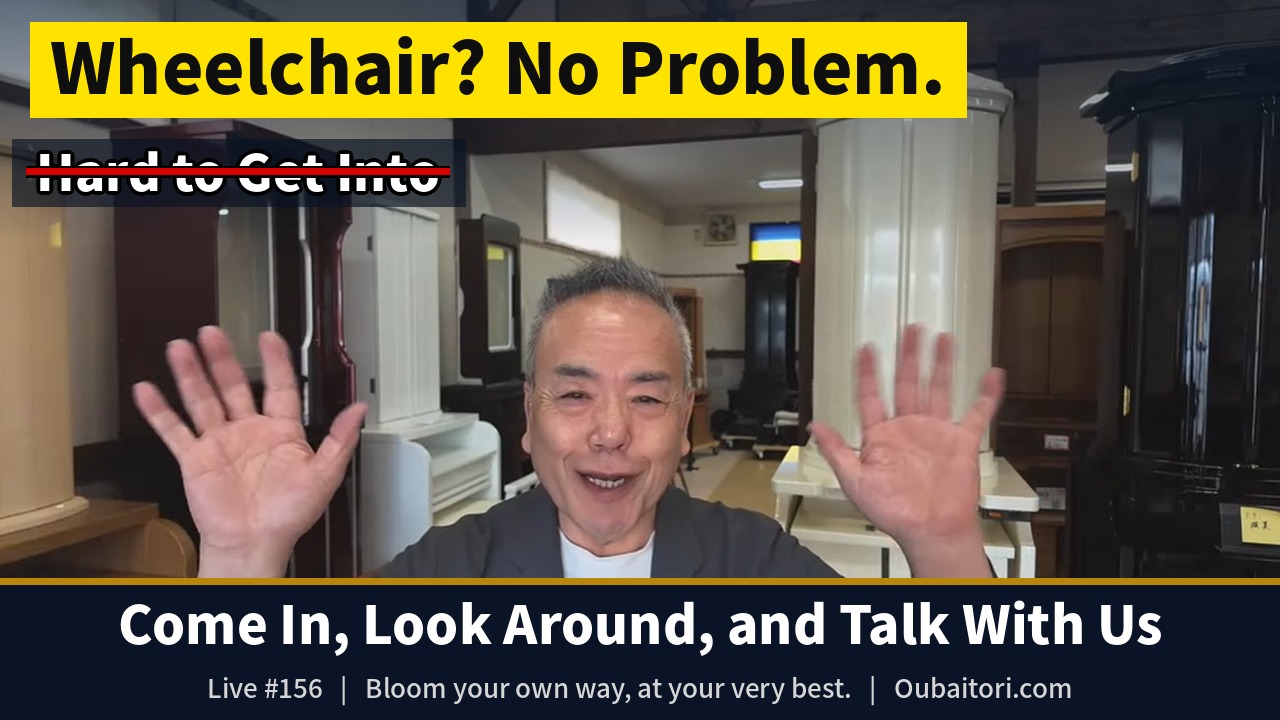
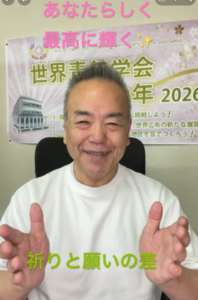
Hello. How are you today? This is Shima of Oubaitori.com. The YouTube live broadcast begins now. Thank you for joining me.
Today is September 5th. How is everyone? There has been a great deal of rain across the country, and these bands of heavy rainfall can appear almost anywhere now.
You can come in a wheelchair and see everything
Some time ago we paved the parking lot, and the entrance became a ramp. Someone in a wheelchair can roll straight in. You take off your shoes to come up into the shop. After that it is all flat, and even that step is only ten centimeters.
So you come up the ramp in your wheelchair, and that step is easy to clear — there is nothing to worry about. The floor inside is level throughout, so that you can look around freely even in a wheelchair.
Every altar sits on a cart that moves
All of the altars are set on carts that can be moved. So if you stop beside the altar you like, and then name the altars you want to see, we bring them to that spot right away, and you can look at two or three of them side by side.
At the old shop there were fixed stands for the altars, so two of us had to lift each altar into place. And to move one from there, we first had to take it down again. At the Oubaitori.com showroom we have moved one step on from that inefficient way of working. Once an altar is set up, one person can move it freely — which also means we can combine altars however we like, for photographs and for video.
How the showroom came to be
Today I want to talk about what we learned from the old shop, how this showroom — the leading specialist showroom for Soka Gakkai Buddhist altars in the northern Kanto region — came to be, and something of what I feel about it.
We were able to open here on May 3rd, 2021. It was right around the time the pandemic hit. Before that, for more than thirty years, we paid rent on a small shop next to the Koga culture hall and worked hard in that narrow space.
When I began to ask what we should do next, Kimura, my successor, was already with us. That shop had parking for two cars. My car took one, and once Kimura’s car or my wife’s car arrived, that was the end of it. Our office was at my home, and we used to film there and store the used altars there, because the shop was too small.
After that, a carpenter who had been my junior in the young men’s division was building a space of about twenty tsubo on his land, so I asked whether he would rent it to us. We were there about two and a half or three years, dealing only in used altars. Twenty tsubo — we shipped out about twenty-five altars from it. That is how we kept going, and then in 2021 we finally moved here.
Thanks to everyone, the parking and the cramped shop that once worried me so much have become parking for thirty cars and room for more than fifty altars. Even so, I sometimes think the shop could be a little wider. The Kokū Zushi has been spreading, and there are variations and many other things I want to do. And on top of that, we have begun to hear from people overseas, little by little.
We will pick you up at Koga Station
We are in Koga, Ibaraki — about fifteen minutes from the Goka interchange on the Ken-Ō Expressway. By train, take the Utsunomiya Line and get off at Koga Station; we will come and collect you from there. Come here, and I think you will find the altar that is exactly right for you. Please do come and see.
In fact, this afternoon we have a visit booked from Gunma. So later I will film a shop tour and post it on the showroom page. We add one about once a week, or every ten days — the old one drops off the back and the new one goes on.
What is most distinctive about the showroom is that you can meet me directly, and we can talk about all sorts of things. Some people tell me, “When it cools down, I am coming just to see you.” I look forward to that. Please come.
Our forty-fifth year: one millimeter a day
We have entered our forty-fifth year as a specialist in Soka Gakkai Buddhist altars, and I have made many large determinations. Chanting daimoku each morning, talking with customers each day, we keep evolving. The ideas keep multiplying.
Some days the difference between yesterday and today is enormous. Other days it is barely a millimeter. It is a small thing. But every day I feel, without question, that we are moving forward, that we are evolving.
I think that itself is faith. I think that itself is what it means to live. I think that itself is changing one’s karma, and human revolution.
My range: thirty years above, thirty years below
The other day a man from the men’s division came by — he wanted to do a little shopping. I see, I said, and if you have the time, let me make you some good coffee. So he stayed and had a cup.
He has retired from work, and his role in the organization became a deputy position — I am not sure which came first — and some time has passed since then. He is having dental treatment now. Sitting there in the chair, we are of the same generation, so I asked him how things had been lately. And after retiring, and after the position ended, he told me plainly that he does not know what to do with his days.
I asked whether he had a hobby, anything at all. He said work and the organization had taken everything he had. And I understand that.
At this age I often think about range. Thirty years above, thirty years below. I am sixty-nine, so ninety-nine above and thirty-nine below. At the bottom, Kimura just fits. At the top, my father is ninety-five and still managing. That, more or less, is my range — my own age, plus or minus thirty. That is about as far as I can reach.
Everything you have lived through is your treasure
Having lived. Having gone through all of it. That fact, that experience, is the treasure of a life. It is your own great asset.
Every person has lived through something difficult. We are born, and there is birth, aging, sickness and death. I do not believe there is anyone whose life simply goes smoothly, whatever it may look like from outside. And precisely because of that, the fact that a person has lived is there, without question.
Of course, however one lives, one lives bearing responsibility for it. It is all one’s own responsibility. Our faith teaches this. And it teaches, too, that faith exists for the sake of how you will live your own life.
What makes me glad to have practiced this faith is simply this: I wanted to live as myself. I wanted to become stronger. I had wishes and hopes of my own, and I wanted to make them real. That is what I practice for. Doing gongyo, taking part in local activities, belonging to the young men’s division and later to groups in the men’s division — I have been given so many experiences. I have nothing but gratitude for it.
There were setbacks too. There was a time when I went to a hospital and was told I had depression. There were hundreds of moments when the business nearly went under. But all of that is what it means to be alive, and nothing else.
People look at me and say I am always working hard, always confident, always full of energy. Inside it is very hard. I am struggling. I am rattling apart, standing at the edge. That is how I live. But I am living. I think the important point is right there.
And still you go on living. If you were only staying alive, you would not have that much spirit, that much fullness of feeling. I have never once bent the determination to evolve by a millimeter, to move forward by a millimeter. Of course, when a person has lost consciousness, they cannot hold such a thing in mind — but there have not been many times like that.
Decide, pray, and move
I have come to think that a life goes roughly the way you think it will go. If you decide for yourself, “I will live this way,” you do move in that direction. That is certain. Something will not simply work out on its own. Someone will not simply fix it for you. That much has become completely clear to me.
A wish alone does not come true. But if you decide, pray, and move — if you do not give up on yourself — you go in that direction, and the protective forces move. Protective forces are movement. Someone appears to help. The timing falls right. You find you were protected. All of that follows from your own will to live, and comes along with it.
If you are powerless, if you have no will, if you think it does not matter — call it listlessness — nothing is going to attach itself to that, either way. It depends on the direction and the will of that force to live, and on how far that force carries you. A car, a motorcycle: open the throttle and the wind comes at you. It is the same with a car — open the window and the air rushes in. Today it is hot, so we have it closed with the air conditioning on. But it is the same thing.
Praise your own life, yourself
So being alive is itself an extraordinary thing, and there is nothing in it but gratitude. And if you are going to be grateful — if you are going to be truly, seriously grateful to your own life — then I think you need to chant Nam-myoho-renge-kyo and praise your own life.
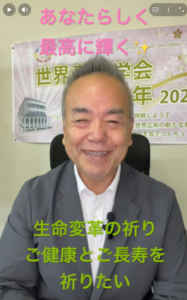
No one else praises you. In a sense, no one else acknowledges you. So you acknowledge yourself. It is words, so first you acknowledge yourself. Nam-myoho-renge-kyo — to bring the power of Bonten and Taishaku into your own life. And on that foundation: for the Soka Gakkai, and for the lives of all our fellow members in this area, may that power enter as well. That is the prayer for transforming life. I want to pray for health and long life. I want to pray for every success and every victory. I send daimoku. To one’s own life, with words, chanting — I think that is where it connects.
And then: what can I do for the one person in front of me? That is the question. I may have wandered a long way from the man in the men’s division, but we talked for ten or twenty minutes, and all of that was going through my head during those minutes. And when we parted, I suggested he try a hobby, some small new challenge.
I built a job with no retirement
I am self-employed, and for the self-employed there really is no retirement age. It ends when I decide to end it. Put bluntly, I work until I die. And that is a gift. I built that situation — being able to work until I die — myself. “I am looking forward to retirement” is not a phrase I have. If anything, retirement is what makes me uneasy.
So at fifty-seven, what I felt about myself — about my own state of life — was this: am I still only here? It is like climbing Mt. Fuji. Still down at the foot of it? Even the foot has its slopes — just reaching the first station is quite hard. The road is not paved. You cut the path yourself.
In the middle of that I thought, this is more than I can manage. And when the anxiety and my own inadequacy became the main thing in my mind, symptoms of depression began to show. But I did not give up there. I was able to rouse myself again, and so I could take the next step.
What made the difference was my wife, my family. If I had been alone, I might have simply fallen ill and stayed there. It would have become an entirely different life. Environment does affect us. So what kind of environment you build has to be part of the scenario of your own human revolution — not just deciding, and nothing more. That is how I have thought about it, and that is how I arrived where I am now.
Yesterday I came home exhausted
Yesterday I came home worn out. My grandchildren were there, and they were probably tired too. They came and pressed up against me. People are the same. At times like that you meet them where they are, and let them lean on you — and by letting them, I felt held myself. They are boys. There are times when that is needed.
Normally they are throwing things, and the jokes are so loud I want to beg for mercy. But yesterday it was like that. And then one of them told me he had saved a sweet for me. Such a small kindness, and it warmed me through.
I was able to marry my wife, to be blessed with children, to see my daughters married, to be blessed with grandchildren. We had our summer gathering not long ago, and carved out memories together. My second daughter and her husband live nearby, and her husband is Kimura, who has been running this shop since May 3rd. It connects. That is what it means to connect.
This flow is what is called kosen-rufu. So how do you build the flow? If you build it, you can feel its weight, its substance. If you only watch the flow, you see the phenomenon, and not the weight.
No two families are alike. Something that looks the same will not turn out the same, and will not feel the same. So the most important thing is to chant Nam-myoho-renge-kyo yourself, and to practice for oneself and for others. By changing your own state of life, there is happiness for oneself and for others. That my wife, my family, my grandchildren are in that flow of happiness — that far is the range I spoke of.
The summer my grandchildren met their great-grandfather
My father is ninety-five. This summer, thanks to everyone, all the grandchildren were together and could talk with him. We even held a question session, and then a second one. The child who asked the questions was meeting his great-grandfather for the first time.
Rather than simply putting them in a room together with nothing to go on, we started with, “Is there something you want to ask your great-grandfather? Something you want to know?” And it became lively. My father was very happy.
How about you? Have you ever met a great-grandparent? I met my great-grandmother on my mother’s side. I never met my great-grandfather on that side. I met my grandmother and grandfather on my father’s side. A great-grandfather is someone I never met. I have no memory of one, and in fact there was none.
This time, all of my grandchildren were able to meet their great-grandfather and to talk with him. At five, at three, at four, the memory may not stay. But they are in the photographs. The surface memory may fade, and still something remains in the life itself — and later, looking at that photograph, they will understand: this is my great-grandfather, and I really did meet him.
That is the kind of historical fact, the kind of reality, I want to make. Have you ever thought that way? It is not easy. People drift away from their family homes, and things happen between parents and siblings. I have had those periods too.
There is no such thing as perfect, or complete. We may move toward it, but it is not complete. It is not perfect. If perfection exists at all, it exists for an instant. And still, aiming for something like that — that may be there. How is it in your own life?
The ramp exists because someone asked
Today I wanted to introduce the showroom a little. And this happened by chance. Someone in a wheelchair asked, “Is it all right if I come?” And then he actually came.
Looking back, I knew him by sight from the young men’s division — he was in a different area, so I only knew his face. Wherever he was, he was there in that wheelchair. He entered the men’s division, he married, and then he got in touch. He wanted to visit the shop, and it began with the question, “Can I see the altars from a wheelchair?” Of course you can. That is why we put in the ramp, and why we built the place this way. That was one of the reasons.
A shop that can return something to the area
When Koga held its city council election, there was parking for the campaign office here, and a room where the staff could rest. So we moved the altars aside and made it into the campaign office. We have a restroom and an office here, so we opened all of it up and lent the place for about ten days. I stayed here the whole time as the caretaker. Things like that happen. I do not know how next year will go, but if we are asked, I intend to take it on gladly.
This is what it means to be able to return something to this area, this organization, in a form you can see. At the old shop, with parking for two cars, we could not have fit the people — five or six at most. It would have been impossible. So perhaps we have moved a millimeter. And the years have passed as well. I went independent at thirty-five, and I am sixty-nine now.
I want to leave behind how Super Grandpa lived
Where is my life now? It is an important question — important to me, and I have talked about it today in case any of it is useful to you. Please leave a comment. I welcome comments that are positive, and that come from faith.
If you are against the Gakkai, or you dislike me, then you can simply not watch. That is fine, and that is how I see it. This is about connection. People who can understand each other do, sometimes with hardly a word exchanged. And there are people who, after all the hours of talking and explaining, still will not. President Ikeda gave guidance on this: there is no need to force yourself to like someone. So there is nothing you must force yourself to do.
You are free. Within your own awareness, walk a good life together with the good friends and good connections through whom you can create value. And if you think something is not right, then let it go cleanly. Welcome those who come; do not chase those who leave. That is all right, I think. And say out loud what you are thinking, or leave it as a record. I think that matters.
For myself: I take the guidance President Ikeda gave, and in my own way, raising my own state of life, I somehow try to practice it — living seriously as one disciple of President Ikeda. That way of living. And through it, I want to pass this faith on to my wife, my children, my grandchildren. My grandchildren call me “Super Grandpa.” Look at how Super Grandpa lived. What kind of life did he walk? I want to leave that behind. That is why I record these live broadcasts on YouTube — as long as this world does not fall apart, they will remain. And it is the same with the books.
May there be no more misfortune than this. No one wants more war than this. Why, then, are there forces that set it in motion? So — President Ikeda’s world peace, worldwide kosen-rufu, humanism. I want to bring that thought to as many people as possible, whoever they are.
If the person in front of you has no strength today, then you say, I see, and that is how today is. There are times like that. But if you lose the will to stand up, if you give up on yourself, then no one can pull you up from there. Even if your strength fails and you sit down hard on the ground, if you say, “Someone help me, I still want to go” — I believe a hand will reach out. If you say it does not matter anymore, then you are only there, only in the way.
So, knowing of one another that each of us is choosing our own life, without getting in each other’s way, without becoming a burden, I want to realize my own views, my own dreams and hopes, and enjoy each single day, creating value as I go. That is how I want to walk. Thank you, as always. Thank you very much.
That brings Live #156 to a close. Thank you for watching to the end. If it becomes a good starting point for something, I am glad. And if you have any questions, please send them. I will be waiting. Goodbye for now.
🙏 From Yukihiro Shima — Oubaitori.com
Bloom your own way, at your very best.
Oubaitori.com — Japan’s specialist in Soka Gakkai Buddhist altars
44 years, one specialty (est. 1982). 17,113 Soka Gakkai Buddhist altars delivered to date. Japan’s No.1 in restoring Soka Gakkai altars, 1,500+ restored. Registered trademark: “Butsudan Revolution — Kokū Zushi.” We ship worldwide.
📱 Talk directly with us (LINE)
Kokū ZushiOnline StoreBooksYouTube
Comments