

“I want to bring daimoku to fellow members around the world.”
“Let’s Daimoku!”
A wish I had quietly held for many years has finally taken shape. The English edition of my book, “Let’s Daimoku!”, is now on sale on Amazon Kindle. Let me begin with that happy news.
Let me be honest. For a long time, chanting daimoku did not come easily to me. I ran a Buddhist altar shop and spoke to others about faith, yet there were times when I myself shied away from chanting.
At sixty-six, I resolved to take on a challenge: ten million daimoku. It was not about logic. I simply wanted to break through my own limits with my own voice. I chanted, and chanted, and chanted again — and in those days I truly felt the “wall” within me begin to crumble, little by little. “Let’s Daimoku!” is the record of that journey. It is not a polished success story. I wrote it for every person who, like me, hesitates over daimoku or feels they are “no good at it,” to say: You will be all right. You can do this too.
At my small butsudan shop in Koga, Ibaraki, fellow SGI members from across Japan began reaching out to me through YouTube. As I connected with more than 6,300 people, another wish took root in me.
Kosen-rufu for the whole world — I wanted to put those words into practice in the humble form of a single book. I am far from fluent in English. Still, if it might give even the smallest push to someone facing their daimoku alone in a distant land, that was reason enough. With that single thought, I set out to create the English edition.
Here I want to confess something honestly.
I do not understand English at all. I cannot read it, write it, or speak it. How could a person like me publish a book in English? Even I find it hard to believe.
For this edition, I created the English version with the help of AI. The finished text was then carefully checked by a native English speaker, who assured me it reads as natural English, written with heart. Teaching the AI, refining the words, and confirming them through a native eye — this is how a book in English was born from the hands of a man who cannot speak it.
Looking back, I am struck by a realization. To chant daimoku is to draw out of yourself an “infinite potential” you never imagined you possessed. A man who cannot speak English, publishing a book in English — the me of not long ago would have laughed at the very idea. And yet, it became real.
The things you believe are impossible for you. The things you have given up on, telling yourself, “I’m too old now.” Are those walls truly impossible to cross? Daimoku taught me the answer.
The road to publication was anything but smooth. I revised the English, paused sales once, and remade the cover.
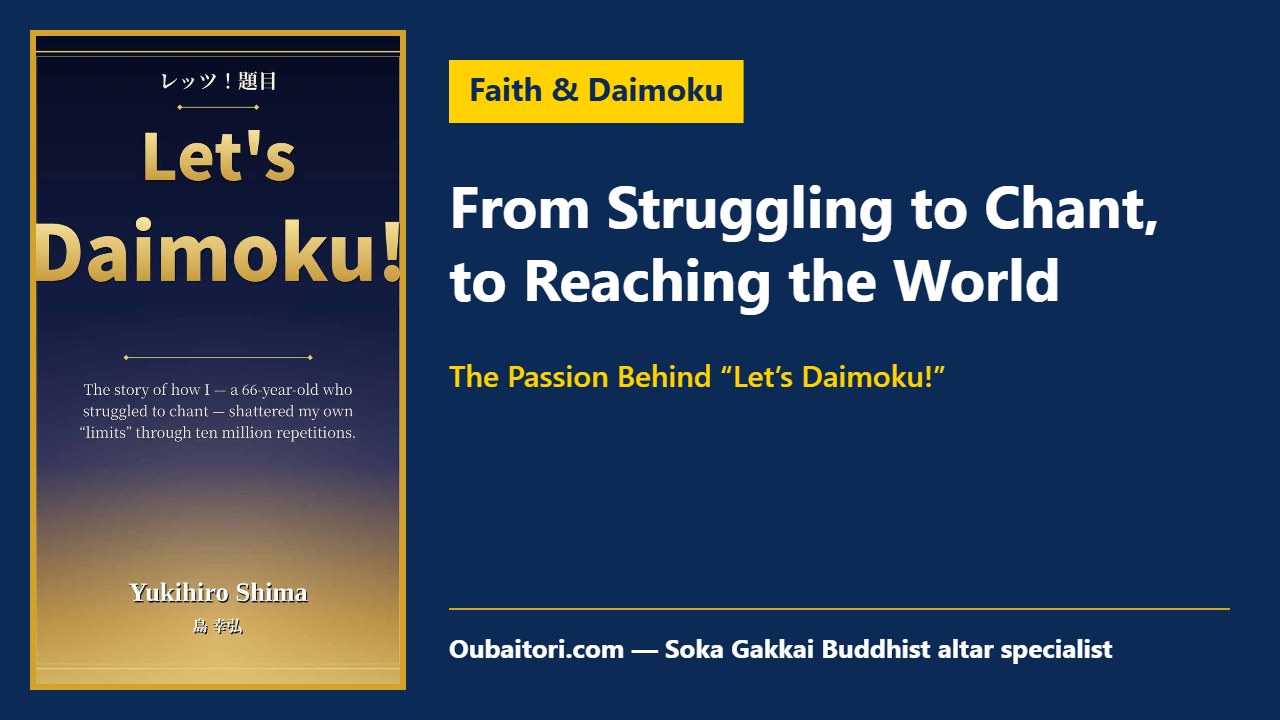
For the new cover, I chose the colors of dawn, shifting from deep indigo into gold. I believe that chanting daimoku is itself the practice of bringing a dawn to one’s own life. After the darkest hour, the light always rises. I chose these colors so that readers in the English-speaking world could sense that at a single glance.
“Let’s Daimoku!” is available now in the Kindle edition (a bilingual Japanese–English paperback is also coming soon).
To anyone hesitating over daimoku. To anyone who, like the old me, feels “I’m just not good at this.” And to that important person of yours striving in faith overseas — please pick it up. I have set down, honestly, the view I saw beyond ten million daimoku.
And if I may hope for one thing more: that you might hold both editions of “Let’s Daimoku!” in your hands — the Japanese and the English alike. Nothing would bring me greater joy. How the same prayer resounds in two languages may itself become a force that helps you believe in your own potential.
Thank you for reading to the very end. If I have been able to lend even a little strength to your daily chanting, there is no greater joy for me.








Comments