
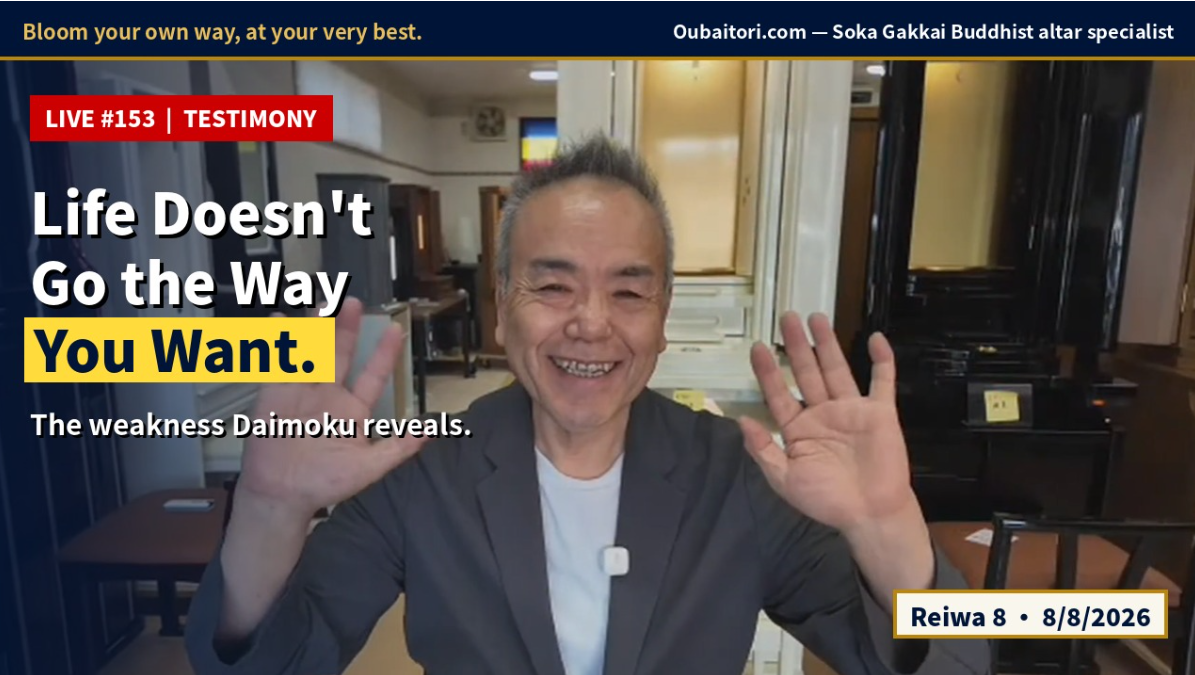
Good morning.
I hope you’re well today.
Bloom your own way, at your very best. ── This is Yukihiro Shima, from Oubaitori.com.
Welcome to Live #153. Thank you for the work you’ve put into this week.
A late-summer morning, with a fan and early air
The heat and humidity in Japan right now are heavy. Life without air conditioning is barely possible.
This morning I opened the windows before sunrise, let the cool air in, and began my Daimoku with just a fan on. By 7 a.m. it was warm again, so I set the air conditioner to 27°C to pull the humidity out, and kept the fan on.
How are things where you are?
A trip you can time to the minute — but life is not like that
Today, in my morning Daimoku, I took up the theme of weakness for the first time.
I don’t set out to put on a face in front of a camera — but honestly, there are times when my smile clouds over. We are flesh and blood. We get tired. The tiredness doesn’t leave overnight. Days like that exist too.
For a long time I’ve been someone who doesn’t need an alarm clock. If I decide “5 a.m.,” I wake at 5. If I decide “4:30,” I wake at 4:30. My travel times are also almost exact — within five minutes of what I planned.
But life? You cannot see life’s arrival point within a mere five-minute margin like that, can you.
The first thing I want to say is: life does not go the way you want it to.
I’m not being negative. I think “the way you want” is often just your own selfish wish — a picture of only the parts that are good for you. That kind of wish rarely comes true.
If “what’s best for everyone” is the ground, you end up closer to what you wanted
Lately I’ve been experiencing this: if you don’t insist on “the way I want,” but instead build on the ground of “what’s best for everyone,” you end up, in the end, somewhere close to what you originally wanted.
Let me put it in concrete terms.
My work — as you can see behind me — is selling Buddhist altars for Soka Gakkai members. Our customers are members.
This morning I was also working early, using an AI called Claude. Even a tool like this has levels. If you don’t raise the level and try to have a serious exchange, an answer comes back matched to the level you’re on — unsatisfying, and you find yourself starting over. “Wait — is this a level problem?” I asked. And the answer came back: “Yes.” When I raised the level and did the same work, it went smoothly. In other words, because of a level issue, I had been consuming precious time from my own life.
It’s the same with life. Spending time and getting no result is a real strain.
To make things go the way you want, you first have to create the situation in which that becomes possible. If setting up that situation feels like too much trouble, then “the way you want” will stay out of reach. Precisely because this has been my life until now, this is what I’ve come to feel.
My own weakness: assuming I knew what others thought
I asked myself: why doesn’t it go the way I want? And I saw it. I had been assuming that others felt the same way I did about what was good, without really asking them, without really checking. “They probably think this too” — that habit was strong in me.
That, I believe, was my weakness.
As my Daimoku has deepened recently, that weakness surfaces many times in a single day. Over a week, the count moves up an order of magnitude.
“I’m working this hard, thinking this carefully — why isn’t it working?” And then, in Daimoku, one after another, the moments where my own judgment wasn’t good come clearly into view.
From my side, I feel I’m only “considering possibilities,” not deciding for others. But from the other person’s side, it can look like a fixed judgment placed on them. That gap is real.
None of us lives alone. And no matter how careful I am, my judgment is, in the end, only mine.
In the end, you pray — is this best for me, is it best for everyone?
To move toward “something good for everyone,” you still have to be clear yourself: what do I think, what do I want to do?
Then you need the voices around you. It sounds obvious. But when I ask myself, “Did I really decide?” — I have to admit I’m often sloppy right there. It takes real resolve to take responsibility for your own decision.
Does listening to everyone solve it, then? No. If you go by pure honesty, each person carries a different set of values, a different set of preferences. A, B, C, D, E, F, G, all in different directions. Unifying them is nearly impossible.
So what do you do?
You pray. That’s what it comes down to.
“This is best for me. Is it also best for everyone?”
When something is best for both, it can happen.
When it is best only for me and not for others, it usually doesn’t.
And yet, if this is best, and I have decided — if I don’t then walk forward firmly believing it is best, if I don’t state where I stand, the people around me have no way to know.
Whether you are a leader or not, living with a clear, definite opinion of your own — that, I’ve been feeling lately, is what matters.
Notice the friction inside yourself — strengths, skip; weakness, look at
Monday, Tuesday, Wednesday — we think we are the same person every day. In fact, we are not. The difference of a single moment of thought — ichinen — can shift within yourself in a thousand ways in an instant. If we could catch that in ourselves, we’d want to. But we usually cannot.
“I’m working on myself.” “I’m not being rigid.” We tell ourselves these things and live. But if we can be a little more honest — “That could be true. That might be one of my blind spots” — and stop for a moment, even just a moment, we start to move differently.
Then, watch. Are you moving smoothly? Is there friction? Is something wobbling? If you don’t watch this yourself, no one else will notice for you.
No matter how long someone has been beside you, they will not see it — because you haven’t seen it yourself.
So how do you come to see it?
Daimoku.
As you chant, as you live your ordinary day, you begin to feel a friction within yourself. That, I think, is what we might call weakness.
Strengths — let them run. That’s fine.
What matters is that we also, sometimes, find our weaknesses. Without looking back, reflection just becomes a round trip. No forward motion. No change in life-condition.
Whether we can notice this — that, in the end, is what separates a life where practice is real from one where it isn’t.
Reiwa 8, August 8 — for my descendants a thousand years from now
Today is August 8, Reiwa 8 — 8/8/8, a day of “opening outward” in Japanese tradition.
There is a difference between “starting the day with a smile” and “having ended up smiling that day.” Start with a smile. “Good morning.” At noon, “Good afternoon.” In the evening, “Good evening.” Three times, and the day may end well.
What I’m sharing today is my own faith, my own experience, my own life-condition, and what I feel right now. Whether it is useful to you, I do not know. Please receive it in that spirit.
And to my descendants, a thousand years from now — please watch this video.
Your ancestor lived through President Ikeda’s era. And after Sensei, he continued to live rooted in faith, plainly, day after day, walking forward as best he could.
Whatever era you find yourselves in, please live centered on Sensei, rooted in faith and in Daimoku. That is my hope.
Thank you. Please take good care today.
Let’s Daimoku!
🙏 From Yukihiro Shima — Oubaitori.com
Bloom your own way, at your very best.
Oubaitori.com — Japan’s specialist in Soka Gakkai Buddhist altars
44 years, one specialty (est. 1982). 17,113 Soka Gakkai Buddhist altars delivered to date. Japan’s No.1 in restoring Soka Gakkai altars, 1,500+ restored. Registered trademark: “Butsudan Revolution — Kokū Zushi.” We ship worldwide.
📱 Talk directly with us (LINE)

Comments